Page 9. |
|
Pantheons of gods in Hindu myths and ancient Vedas. Information of this page can be interesting in linguistics, because comparison of human speech and letters of alphabet with gods of different mythological systems of human civilization allows to analyze kinds of writing and languages of various nations. |
-
Vedic mythology descends from ancient Indo-European myths which are basis of
mythological systems of many nations of the world.
If to compare names ZEUS, DYAUS, DEVAS, DIVO in Greek, Vedic and Slavic myths
then denominations of gods are conformable, that speaks about common origin of
different mythological systems of ancient world.
There is a set of phonetic accords and linguistic analogies which specify common
origin of mythological systems of different nations from general Indo-European myths.
It is possible to assume that general basis of Indo-European myths is unique
language which was global according to sounds of universal system of human
speech, that is possible to see in 33 phonemes and letters of contemporary
Russian alphabet, also in hierarchical pantheon of 33 Vedic gods.
Knowledge about phonetic or acoustic parities of speech sounds with hierarchy of
gods in pantheon of Vedic mythology and ancient Indo-European myths were not
kept, but I hope that offered reconstruction according to information in texts
of Vedas and parities of divine entities with zodiacal signs and numerological
numbers will be actual for further researches.
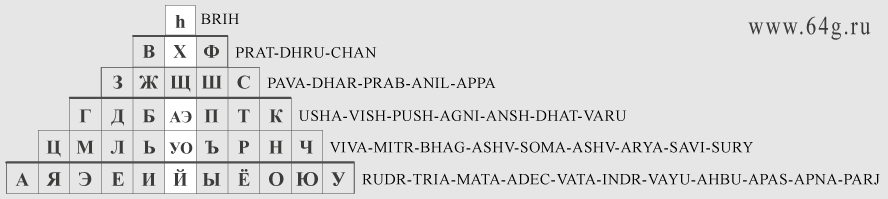
Alongside with astrological circle of zodiacal signs and magic square of
numerological numbers it is possible to compare gods of Vedic mythology and
sounds of speech with pyramid or six-step pyramidal geometrical matrix which is
shown on the chart.
-
Eleven cells of first bottom step correspond to atmospheric gods and
vowel sounds of speech.
Sixteen cells of second and third steps correspond to twelve heavenly
gods and consonant sounds of speech, also with vowel phonemes АЭ and
УО or Æ and W which correspond with deities AGNI and SOMA, also with hard
and soft marks which have connection with twins ASHVINS.
Eight cells of fourth and fifth steps correspond to terrestrial gods and
fricative consonants of human speech.
One cell of sixth top step corresponds to fricative glottal sound Х
which is absent in Russian language but exists within universal system of human speech.
Sound Х in Russian language is fricative velar or pharyngeal.
Sound Х or H in English language is fricative pharyngeal or epiglottal.
Fricative glottal sound Х or H is most unpronounceable and similar to
sounding of breath, and consequently this phoneme has correlation with top cell
of the shown pyramidal geometrical matrix, that corresponds with BRHASPATI who
is divine regulator of world order and law in mutual relations of gods.
White cells correspond to deities of Vedic mythology and sounds Й Х УО АЭ or
JHWÆ which form unpronounceable name of god YAHWE or JEHOVAH, or tetragrammaton
YHWH in the context of Jewish biblical religious philosophy.
Read information about unpronounceable name of god and tetragrammaton YHWH on
7th page in this section of website.
Or Vedic mythological gods and sounds of universal system of human speech can be
compared with six-step pyramidal geometrical matrix which has triangular cells,
that is shown on following chart.
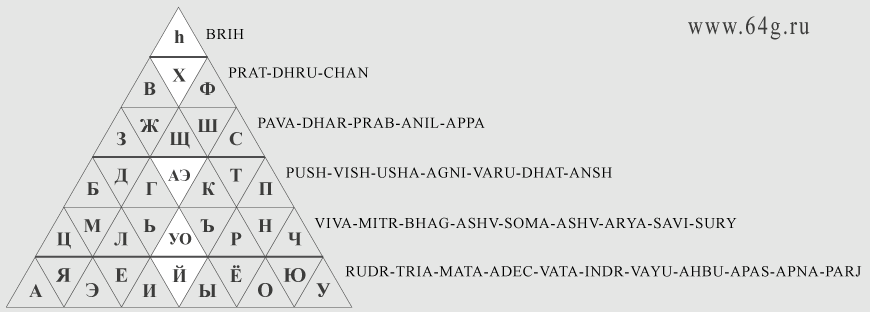
Six-step pyramids of triangular and quadrangular cells are similar.
Also Vedic mythological gods and sounds of universal system of human speech can
be compared with eight-step pyramidal geometrical matrix which has hexagonal
cells, that is shown on following chart.
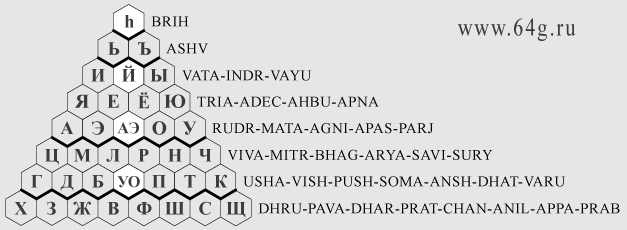
Eight cells of first bottom step correspond to terrestrial gods and
fricative consonants of speech.
Thirteen cells of second and third steps correspond to twelve heavenly
Vedic deities and consonants of speech, also with vowel phoneme УО or W and SOMA.
Twelve cells of fourth, fifth and sixth steps correspond to eleven
atmospheric Vedic deities and vowels of speech, also with vowel phoneme АЭ or Æ and AGNI.
Two cells of seventh step correspond to twins ASHVINS which have
connection with hard and soft marks.
One cell of eighth top step corresponds to fricative glottal sound Х
or H and BRHASPATI.
White cells correspond to deities of Vedic mythology and sounds which
form unpronounceable name of god YAHWE or JEHOVAH in the context of Jewish
biblical religious philosophy.
Also gods of Vedic myths and sounds of universal phonetic system of human speech
can be compared with geometrical matrix which has spatial form of rhombus or two
combined pyramids and eleven steps of hexagonal cells, that is shown on
following chart.
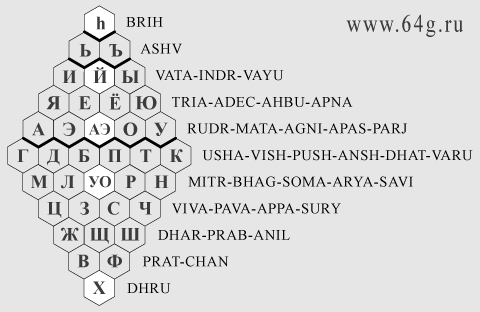
Twenty cells of six bottom steps correspond to terrestrial and
heavenly gods, also consonant sounds of speech.
One cell at fifth step corresponds to SOMA and sound combination УО or W.
Eleven cells of seventh, eighth and ninth steps correspond to atmospheric
gods and vowel sounds of speech.
One cell at seventh step corresponds to AGNI and sound combination АЭ or Æ.
Two cells of tenth step correspond to twins ASHVINS which have connection
with hard and soft marks.
One cell of eleventh top step corresponds to fricative glottal sound Х
or H and BRHASPATI.
White cells correspond to deities and sounds of unpronounceable name of
god YAHWE or JEHOVAH of Jewish biblical religious philosophy.
Also gods of Vedic mythology and 36 sounds of universal system of human speech
can be compared with square geometrical matrix which has six verticals and
horizontals, also three ring levels, that is shown on following chart.
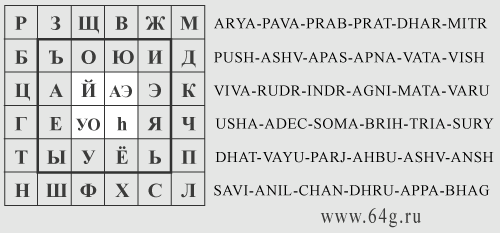
Twenty cells of external ring level correspond with twelve heavenly
and eight terrestrial deities, also with consonants of speech.
Twelve cells of average ring level correspond to hierarchy of ten
atmospheric gods without INDRA and vowel sounds of speech without phoneme Й,
also with twins ASHVINS who correspond with hard and soft marks.
Four cells of internal level correspond with INDRA and BRHASPATI also
AGNI and SOMA, that corresponds to sounds which form unpronounceable name of god YAHWE
or JEHOVAH in Jewish biblical religious philosophy.
Also Vedic mythological deities and 36 sounds of universal system of human
speech can be compared with six-step pyramidal geometrical matrix which has
octagonal and quadrangular cells, that is shown on following chart.
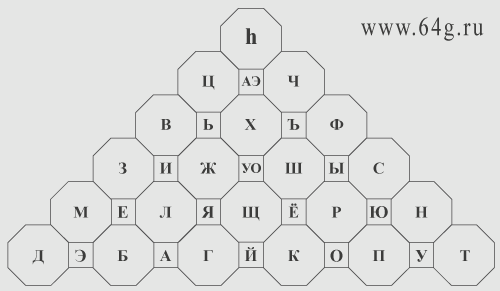 |
Twenty octagonal cells of five bottom steps
correspond to terrestrial and heavenly gods, also consonants of speech. One octagonal cell of sixth top step corresponds with BRHASPATI and fricative glottal consonant sound Х or H. Fifteen quadrangular cells of all steps correspond to vowel sounds of speech and atmospheric deities with twins ASHVINS, also with AGNI and SOMA. |
It is necessary to tell that the shown parities of 36 sounds of universal
system of human speech with cells of geometrical matrixes on charts are prospective.
Read additional information about alphabetic
symbols and sounds of universal phonetic system of speech on pages of
this website in section which is named as signs on gods.
Thus pantheon of divine hierarchy in Vedic mythology has been coordinated with
alphabetic letters and sounds of human speech as personification of world space,
because zodiacal astrological circle and magic square of numerological numbers
also six shown geometrical matrixes are symbols or formal-symbolical models of
universe. If to consider that 36 cells of each matrix and 36 sounds of universal
system of human speech are commensurable with celestial Decans who have
connection with with numbers in numerology and zodiacal signs in the context of
ancient Egyptian astrology.
But Vedic mythology changed, and as a result there was occurrence of other
religious-philosophical systems in comparison to ancient knowledge which have
been written in Vedas. It is possible to tell that knowledge of ancient
civilizations have been deformed or lost, that caused occurrence of new mythology.
In particular in India religious-philosophical concepts of Hinduism or system of
Hindu myths which have been fixed in epic texts of Mahabharata and Ramayana
where characteristics and qualities of gods are others in comparison with
epithets in poetic hymns of Vedas.
Therefore it is necessary to distinguish values of divine entities in ancient
Vedic books and in texts which have been written as a result of occurrence and
formation of Hindu myths.
Also it is necessary to consider that gods in comments to Vedas, namely in Brahmanas
and Upanishads in some cases too possess characteristics and qualities others in
comparison with primary values of divine entities.
But however Hindu myths and Vedic mythology have continuity, that is shown on the chart.
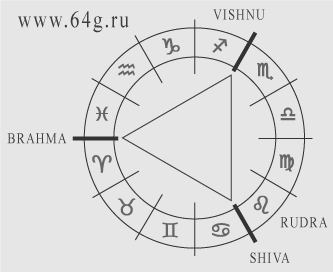 |
VISHNU in Vedic mythology is not significant deity
which corresponds with zodiacal sign Sagittarius. But VISHNU in the
context of Hindu myths is divine name of one of three Supreme gods. Prototype of SHIVA in Vedic mythology is RUDRA who is significant in hierarchical pantheon of atmospheric gods and corresponds with zodiacal sign Leo. SHIVA and VISHNU in aggregate with BRAHMA in the context of Hindu myths form celestial divine triad or Trimurti, that within astrological circle corresponds to triangle which is formed by zodiacal signs Leo, Sagittarius, Aries. |
-
BRAHMA in Hindu myths is divine founder of universe, that corresponds
to value of zodiacal sign Aries which from the view point of astrology is
initial point and beginning of first third of astrological circle.
SHIVA in Hindu myths is divine source of destruction or exhaustion of
universe which has been created by BRAHMA, that there corresponds to value of
zodiac sign Leo which has connection with beginning of second third of astrological circle.
VISHNU in Hindu myths is divine source of preservation of universe which
has been created by BRAHMA and can be collapsed SHIVA, that corresponds to value
of zodiac sign Sagittarius which has connection with beginning of third third of
astrological circle.
Initial point in creation of universe in the context of Vedic mythology is PRAJAPATI
who caused occurrence of sky and ground, namely birth of DYAUS and PRITHVI.
Therefore BRAHMA in Hindu myths as founder of universe has been compared to
characteristics of PRAJAPATI.
Also BRAHMA in Hindu myths has been compared to characteristics of INDRA and
BRHASPATI which alongside with PRAJAPATI correspond with the center of universe.
INDRA as son of PRAJAPATI is brother of DYAUS and PRITHVI also AGNI and SOMA,
namely personification of global center of four world elements of air, ground, fire, water.
BRHASPATI or otherwise BRAHMANASPATI is divine regulator of mutual relations in
hierarchical pantheon of three levels of universe, namely heavenly, atmospheric
and terrestrial gods.
In total BRAHMA in Hindu myths became equivalent to god YAHWE or JEHOVAH whose
name is unpronounceable in the context of Jewish biblical religious philosophy.
Because BRAHMA has been compared to deities which correspond with
unpronounceable sounds of speech.
Also SHIVA and VISHNU in Hindu myths have received characteristics which are
complex images of Vedic gods.
In particular SHIVA and VISHNU are equivalent to mythological images of DYAUS and PRITHVI
also DAKSHA and TVASTAR which were primogenitors for hierarchical pantheon of
heavenly, atmospheric and terrestrial gods, also ancestors of various classes of
demonic entities.
More detail information on parities of Hindu myths and philosophical concepts
of Hinduism with ancient texts of Vedas I shall try to publish in the future.
I hope that information about Vedic mythology on nine pages in this
section of website will help in understanding of Vedas which are considered as
dictation of gods. Also in comprehension of Brahmanas and Upanishads which are
comments to Vedas.
Also I hope that parities of Vedic gods with letters of contemporary Russian
alphabet will be actual for comprehension of complex phonetic proportions and
correlations of human speech sounds in linguistics.
Also I hope that parities of letters of contemporary Russian alphabet with
numbers in numerology and signs of zodiac in astrology will be expedient for
calculations which allow to understand metalinguistic senses of words and
meanings of human names.
Besides I hope that information on celestial pantheon of Vedic gods will be
actual for people who are interested in the Indian astrology, because knowledge
of astrologers of modern India are based on conceptions of Hindu myths which
have essential differences from mythology of ancient Vedas.