Page 7.
|
|
Name of god and mythology of mankind. Information of this page can interest theosophists and theologians, because name of god or tetragrammaton YHWH is combination of sounds which from the view point of universal system of human speech are unpronounceable, but they are phonemes which mean display of invisible God in space of universe for comprehension by mankind. |
-
Terrestrial gods Vasus and heavenly Adityas also atmospheric Rudras in the
context of Vedic mythology form common or indivisible pantheon which correspond
with different levels of world reality. Therefore Vasus are displays of heavenly
and atmospheric gods on terrestrial level of universe.
Eight terrestrial Vedic gods correspond with fricative consonant sounds В Ф З С Ж Ш Щ Х.
ВФ, ЖШ, ЗС form conformable pairs of voiced and unvoiced sounds.
Щ is soft sounding of phoneme Ш and corresponds with pair ЖШ.
Ж Ш Щ З С form group of five hissing and sibilant sounds.
В Ф are not hissing or sibilant sounds.
Х is particular sound among fricative consonants because of acoustic
connection with phonemes Г and К.
The listed phonetic features of eight fricative consonant sounds of speech also
hierarchical structure of terrestrial gods can be presented as chart.
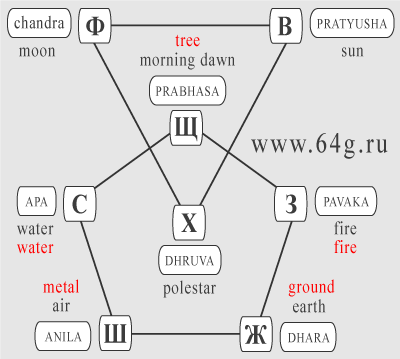 |
В Ф Х form symbolical triangular figure where
two apexes correspond with pair of conformable phonemes В Ф, and
sound Х is compared with third apex, that corresponds to
mythological notions about cosmic egg which is source for dual pair of
two forces of universe, namely two golden germs which possess opposite
male and female qualities. Sound Х - cosmic egg - DHRUVA - polar star. Sound В - male quality - PRATYUSHA - sun. Sound Ф - female quality - CHANDRA - moon. DHRUVA is terrestrial analogy of INDRA, because polar star is center of heavenly sphere, also INDRA is central god of Vedic mythological pantheon. PRATYUSHA is terrestrial analogy of AGNI, because Sun is source of fiery energy, also AGNI personifies celestial fire. CHANDRA is terrestrial analogy of SOMA, because Moon influences water elements of universe, also SOMA personifies celestial waters. |
-
Ж Ш and З С are pairs of conformable voiced and unvoiced sounds
which form symbolical quadrangle of four world elements, namely fire, earth,
air, water in the context of classical Greek philosophy.
Sounds Щ С Ж Ш З form symbolical pentagon which corresponds with five
elements or substances in the context of Chinese philosophy.
Sound С - elements of water - substance of water - APA.
Sound Ш - elements of air - substance of metal - ANILA.
Sound Ж - elements of earth - substance of ground - DHARA.
Sound З - elements of fire - substance of fire - PAVAKA or ANALA.
Sound Щ - substance of tree - PRABHASA.
Read information about five substances of Chinese
philosophy on pages of other website emotions.64g.ru,
namely about philosophical concepts San Gan Wu Chan or three foundations and
five constancies which correspond to phonetic triangle В Ф Х and pentagon С Ж Ш З Щ.
According to parities with world elements it is possible to compare terrestrial
Vedic gods and corresponding sounds of speech with zodiacal signs and
numerological numbers within astrological circle, that is shown on the chart.
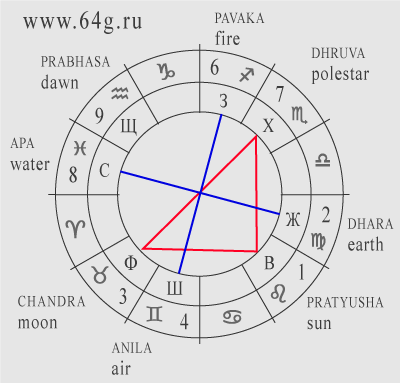 |
PAVAKA - З - Sagittarius - number 6. PRABHASA - Щ - Aquarius - number 9. APA - С - Pisces - number 8. CHANDRA - Ф - Taurus - number 3. ANILA - Ш - Gemini - number 4. PRATYUSHA - В - Leo - number 1. DHARA - Ж - Virgo - number 2. DHRUVA - Х - Scorpio - number 7. Eight terrestrial gods are displays or reflections of twelve heavenly deities. But terrestrial Vedic gods have connection with global world categories of matter, energy, space, time, because these divine entities cannot be connected with cardinal zodiacal signs which correspond with categories of life and movement. Read information about parities of astrological signs of zodiac with axes of global world categories on previous 6th page in this section of website. |
Name of god PAVAKA means fire and corresponds with zodiacal sign
Sagittarius where fiery elements of universe is shown.
Name of god APA means water and corresponds with zodiacal sign Pisces
where water elements of universe is shown.
Name of god ANILA means a wind and corresponds with zodiacal sign Gemini
where air elements of universe is shown.
Name of god DHARA means ground and corresponds with zodiacal sign Virgo
where terrestrial elements of universe is shown .
Name of god PRATYUSHA means solar image and corresponds with zodiacal sign Leo
where Sun dominates.
Name of god CHANDRA means lunar image and corresponds with zodiacal sign
Taurus where Moon exalts.
Name of god PRABHASA means morning or evening dawn, namely visible line
of horizon, and consequently this mythological deity corresponds with zodiacal
sign Aquarius. Because symbolical horizon within astrological circle is line
which connects beginning of zodiac sign Aquarius with point between signs of
zodiac Crab and Leo where Moon and Sun dominate.
PRABHASA has location in the middle of triangle which is formed by CHANDRA, PRATYUSHA,
DHRUVA, and in essence in triangular figure which is symbol of astronomical
ratio of Moon and Sun with stars which can be above or below line of horizon,
and as a result can be visible or invisible.
Name of god DHRUVA means polar star or astronomical center of sidereal sphere of
firmament, and consequently this mythological god corresponds with zodiacal sign
Scorpio. Because polar star has location in world center of cosmic egg from
which there was origin of Sun and Moon, also there was birth of VIVASVAT who
corresponds with zodiacal sign Scorpio.
Because VIVASVAT in the context of Vedic mythology is heavenly god who was born from egg.
DHRUVA or polar star has location in pentagon which is formed by APA, ANILA, DHARA, PAVAKA, PRABHASA,
and in essence in the middle of four world elements and five substances of universe.
DHRUVA and PRABHASA are the interconnected deities, because Scorpio and Aquarius
are zodiacal signs where exalting and dominating planet is Uranus which is
mystical symbol for astronomical system of spatial coordinates which are formed
by polar star and line of horizon. Because URANUS in the context of Greek
mythology is deity who is connected with world center as divine parent of twelve
Titans which correspond with zodiacal astrological circle.
DHRUVA and PRABHASA are key deities in the middle of pentagon and triangle
according to which hierarchical structure of terrestrial Vedic gods is formed.
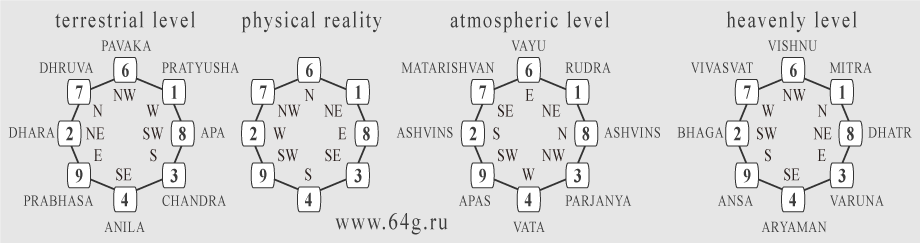
Terrestrial, atmospheric and heavenly gods of Vedic mythology according to
parities with numerological numbers correspond with reference points of
geographic orientation or directions of light in world space, that is shown on
the following chart.
-
The shown octagons correspond to points of geographic orientation according
to different levels of world space.
Terrestrial gods.
DHRUVA - polar star - north - 7.
DHARA - ground - northeast - 2..
PRABHASA - dawn - east - 9.
ANILA - wind - southeast - 4.
CHANDRA - moon - south - 3.
APA - water - southwest - 8.
PRATYUSHA - sun - west - 1.
PAVAKA - fire - northwest - 6.
Terrestrial gods exist in space which has other parities with points of
geographic orientation rather than physical reality of universe where people have existence.
Physical reality of universe.
North - number 6.
Northeast - number 1.
East - number 8.
Southeast - number 3.
South - number 4.
Southwest - number 9.
West - number 2.
Northwest - number 7.
Physical reality of universe has other parities with points of geographic
orientation rather than levels of world space where terrestrial, atmospheric and
heavenly gods have existence.
Atmospheric gods.
Eastern ASHVIN - north - 8.
RUDRA - northeast - 1.
VAYU - east - 6.
MATARISHVAN - southeast - 7.
Western ASHVIN - south - 2.
APAS - southwest - 9.
VATA - west - 4.
PARJANYA - northwest - 3.
Atmospheric, terrestrial and heavenly gods possess various parities with points
of geographic orientation because of existence on different levels of world space.
Heavenly gods.
MITRA - north - 1.
DHATR - northeast - 8.
VARUNA - east - 3.
ARYAMAN - southeast - 4.
ANSA - south - 9.
BHAGA - southwest - 2.
VIVASVAT - west - 7.
VISHNU - northwest - 6.
Parities of Vedic mythological gods with numerological numbers and points of
geographic orientation on different levels of world reality can be interesting
in the context of Chinese Feng Shui. Namely in view of logical geomantic system
for spatial positioning of objects in interiors or landscape design and garden art
according to reference points of world space. Because various schools of Feng Shui
consider trigrams of the Chinese Canon of Changes I-Jing or eight symbols Ba Gua,
but also positioning of objects in interiors or landscape design and garden art
can be possible according to parities of Vedic mythological gods with reference
points of geographic orientation or directions of light in world space.
Because gods of Vedic mythology are prototypes of celestial Guardians or Lokapalas
who in the context of Hinduism or Hindu myths correspond with reference points
of geographic orientation and cosmic elephants which are basis of universe.
Though Lokapalas in Hindu myths have other names rather than gods in Vedas.
Opposite numerological numbers within the shown octagons form mathematical sum
10, that corresponds with principle of magic square.
Central number 5 in magic square corresponds with key gods in the middle of
universe without connection with reference points of geographic orientation.
To the middle of atmospheric level of universe there corresponds INDRA.
To the middle of heavenly level of universe there correspond AGNI and SOMA which
are children of DYAUS and PRITHVI, also brothers of INDRA.
Any middle of terrestrial level of universe is absent, but
DHRUVA is personification of polar star and central world axis. Because
DHRUVA is brother of INDRA also AGNI and SOMA.
In total the middle of world in space of physical reality of universe is
connected with deities which correspond with phonetic sounds Й Х УО АЭ or
JHWÆ if phonemes are written by Latin letters, that corresponds to the name of
god YAHWE or JEHOVAH.
Phonetic combination of sounds Й X УО АЭ or JHWÆ can be considered as
secret mystical code of divine name which has been named or proclaimed for Moses
on mountains Horeb and Sinai in the context of biblical mythology.
According to rules of Jewish biblical scriptures this secret mystical name of
god has notation by means of four letters or tetragrammaton YHWH. And priests
according to religious canons pronounced alphabetic characters of tetragrammaton YHWH
once a year. Another time mystical name of god was forbidden for pronouncing.
Tetragrammaton YHWH was ciphered written designation of unpronounceable name of
god in sacred biblical texts. But if people read the Bible or other religious
books then said written signs YHWH as YAHWE or JEHOVAH, that is conditional
pronouncing of secret mystical code of divine name.
Phonemes Й X УО АЭ or JHWÆ are silent or voiceless in articulation of
human speech as sounds which have no obvious sounding, and consequently it is
possible to assume that name of god was unpronounceable in the context of
biblical mythology and Jewish religious philosophy because of impossibility for proclaiming.
Poetic verses of Dante Alighieri in Divine Comedy have information that Adam
correlated sound Й to name of god. Because Adam was first man who gave
names to animals and birds, also he has named the god as Й, that
corresponds to unpronounceable sound of speech.
Also biblical Moses on mountains Horeb and Sinai
has heard divine name of four unpronounceable sounds.
Also Greek mythology has information about silent eulogizing exclamation JAKH EVOE
which was secret or esoteric name of mythological deity DIONISUS, that is
comparable to unpronounceable phonemes Й АЭ Х УО АЭ or JÆHWÆ of sacral
denomination YAHWE or JEHOVAH.
Also there is known unpronounceable name Й АЭ УО Х or JÆWH in Latin letters
which can have pronunciation as JAWAOH or SEBAOTH, also SHABAOTH or JALBAOTH, that in contexts
of Jewish religious philosophy and Gnostic Christian mysticism is denomination of
celestial sovereign of heavenly armies of incalculable angelic forces of archangels MICHAEL, GABRIEL, URIEL,
RAPHAEL who are equivalent to voiceless sounds JHWÆ and images of four animals
or existential beings around of divine throne in the Revelation of John.
Vast armies of angels or incalculable forces of divine hierarchies form
coordination of consistent chorus of voices which uplift praise to the sacred
name of unique god, that can be compared with complex set of human speech sounds
of all languages of mankind, also with universal system of alphabetic symbols of
contemporary Russian alphabet which is commensurable with celestial pantheon of
Vedic mythological gods.
It is possible to assume that ancient Vedic mythology has parallels with
philosophical concepts of Jewish religion and Gnostic Christian mysticism, also
with Greek myths, because texts of Vedas are assembly of poetic hymns which have
been created before declaration of name YAHWE or JEHOVAH to biblical Moses on mountains Horeb
and Sinai, also before eulogizing exclamation JAKH EVOE in honor of Greek
mythological deity DIONISUS.
Though Vedic Sanskrit in texts of Vedas differs from Greek language and Aramaic
writing in the Bible, but it is possible to assume that information about
unpronounceable name of invisible god has been initiated by unique will of
divine LOGOS who has compared letters of denomination to unpronounceable
phonemes of human speech, also with Vedic mythological deities which correspond
to the center of universe.
Texts of Vedas have information about goddess VAC or VACH who was
personification of human speech and essence of language, namely mythological
entity of perception and comprehension of universe by mankind according to word
meanings which result from logical correlation of world reality to
alphabetic letters and phonetic sounds which form metalinguistic sign system and
exist as image of divine hierarchies.
Also Cabbala in the context of Jewish religious philosophy have information that
22 letters of alphabet and 10 ciphers are image of conceptual or mystical name
of god, and in essence metalinguistic sign system according to which people not
only perceive and realize physical reality of universe but also distinguish
phenomena of divine world.
Goddess VACH of Vedic myths, also set of 22 alphabetic letters and 10 ciphers of
Jewish Cabbala are equivalent of of Christian mystical LOGOS who in the Gospel
of John has description: "In the beginning was the Word, and the Word was with God, and
the Word was God".
Pay attention that 22 alphabetic letters and 10 ciphers of Jewish Cabbala can
be compared to contemporary Russian alphabet if one character is especial,
because 22+10=32+1=33.
Following page shows methods of numerological calculations which allow to correlate letters of alphabet in words or names of people to characteristics of mythological gods.