| Page 1.
|
|
Phonetic structure of language and mythological gods in Vedas. Information of this page can be interesting to people who study foreign languages, also to philologists and linguists. Because according to parities of speech sounds and letters of Russian alphabet with hierarchy of mythological gods in Vedas it is possible to analyze phonetic structure of different languages of mankind. |
-
Vedic mythology is set of myths which are fixed in Vedas or sacred texts of
Indian Aryans at second millennium B.C.
Vedas are sacred books in which indisputable certificates and authoritative
knowledge are written, or otherwise to tell transcendental revelations about
phenomena of world, also about vital essence of gods and people. Because it
affirms that Vedas comprise all Universe and all alive essences are their part.
Actually Vedas are assembly of poetic hymns which describe structure of divine
hierarchies and mystical essence according to which gods are shown among people
in space of physical reality of universe.
Texts of Vedas are written by letters of Vedic Sanskrit which is sacral language
of Hindu priests in religious rituals.
Contemporary scientific linguists assume that Vedic Sanskrit is the most ancient
language of mankind. And philosophers of ancient India approved that Vedas are
divine source of human speech, and in essence initial source of language by
means of which the first person named and realized world phenomena.
Statement of Indian philosophers that Vedas are divine source of human speech
can be comprehended literally. Namely hierarchy of Vedic gods can be correlated
with phonetic structure of language and acoustic parameters of human speech.
Hymns of Vedas and other mythological Vedic texts describe hierarchical pantheon
of 33 basic gods which form 3 groups or classes.
Heavenly Adityas - 12 gods.
Atmospheric Rudras - 11 gods.
Terrestrial Vasus - 8 gods.
Also Ashvins or two twins who are independent but connected with atmospheric gods.
Divine hierarchy of 33 gods in Vedic mythology is equivalent to 33 letters of
alphabet and phonetic structure of contemporary Russian language, that is shown
on the chart.
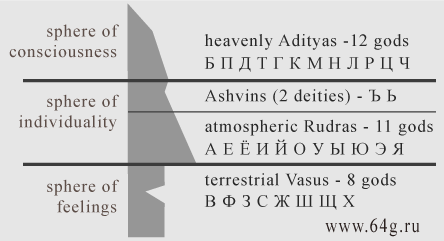 |
Groups of Vedic gods on the chart are compared with
symbolical image of human face in and physiognomic spheres which
correspond to three levels of universe. Heavenly Adityas - sphere of consciousness. Atmospheric Rudras and Ashvins - sphere of individuality. Terrestrial Vasus - sphere of feelings. Look information about levels or spaces of universe and physiognomic spheres of human face on pages of other website: emotions.64g.ru. |
-
Contemporary Russian language differs from Vedic Sanskrit but has unique
phonetic structure which is optimum within common acoustic system of human
speech sounds . Namely letters of contemporary Russian alphabet are symbols or
characters for universal set of sounds within common phonetic system according
to which all languages of mankind are constructed, if to not consider complex
sound combinations and specific phonemes.
Therefore letters of alphabet and sounds of speech in Russian language are
commensurable with hierarchy of gods in Vedic mythology.
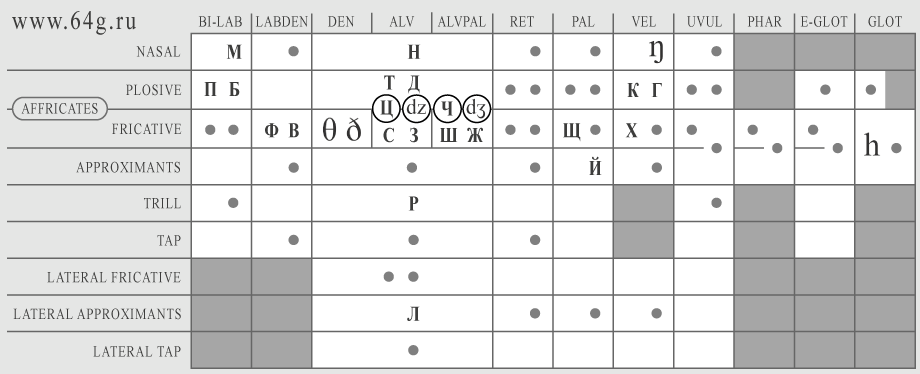
Acoustic parameters of sounds are caused by different ways for formation of air
jet, also by various positions of speech organs during pronunciation or
articulation, that is shown in the table.
-
Cells of the shown table correspond to consonant sounds of speech of common
acoustic system and letters of International Phonetic Alphabet of all known
languages of mankind.
Grey cells correspond to sounds which cannot be said by human speech organs.
White cells correspond to sounds which can be said by people.
Each cell corresponds to positions of two sounds, namely left unvoiced and right voiced.
Letters of Russian alphabet and dark points designate positions of sounds which
exist in various languages of mankind.
Empty positions of white cells correspond to sounds which can be said by people,
but absent in any known languages.
Twelve verticals of the table correspond to positions of speech organs during articulation.
BI-LAB - bilabial - coordination of lips.
LABDEN - labiodental - coordination of lips and teeth.
DEN - dental - coordination of tongue and teeth.
ALV - alveolar - coordination of tongue and alveolus.
ALVPAL - palatoalveolar - postalveolar and prepalatal - coordination of
tongue with alveolus and hard palate.
RET - retroflex - coordination of tongue tip and back part of alveolus.
PAL - palatal - coordination of tongue and hard palate.
VEL - velar - coordination of back part of tongue and soft palate.
UVUL - uvular - coordination of back part of tongue and uvula of palate.
PHAR - pharyngeal - coordination of tongue basis and pharyngeal wall.
E-GLOT - epiglottal - coordination of pharyngeal walls.
GLOT - glottal - coordination of shutters of vocal chords.
Nine horizontals of the table correspond to ways for formation of air jet during articulation.
Nasal resonant consonants are formed when organs of speech during
articulation are closed and air jet passes through nose.
Plosive consonants are formed when organs of speech are closed and then
disclosed during movement of air jet.
Fricative consonants are formed during articulation when organs of speech
create narrow passage for air jet.
Affricates or occlusive-constrictive consonant sounds are formed when
organs of speech are closed and then disclosed not completely during movement of air jet.
Affricates are intermediate phonemes which have articulation as combination of
plosive and fricative consonants.
Approximant sounds are formed when organs of speech create passage, but
movement of air jet is not turbulent as during articulation of fricative
consonants, also not free as during pronouncing of vowels.
It is possible to tell that approximants are intermediate phonemes between
vowels and fricative consonants.
Trill resonant consonants are formed as result of vibration of air jet
during several cycles of closing and disclosing of speech organs.
Tap resonant consonants are formed during one cycle of closing and
disclosing of speech organs as result of acoustic flap without vibration of air jet.
Common set of trill and tap resonant phonemes within acoustic system of
International Phonetic Alphabet is derivative of sound R.
Lateral fricative consonants are formed when organs of speech are closed
and air jet passes through narrow passage along edges of tongue.
Lateral approximants or lateral resonant consonant sounds are formed when
organs of speech remain closed in the middle with disclosing on each side of
oral aperture during movement of air jet along edges of tongue.
Lateral tap resonant consonants are formed when organs of speech as
result of acoustic flap remain closed in the middle with disclosing on each side
of oral aperture.
Common set of lateral phonemes within acoustic system of International Phonetic
Alphabet is derivative of sound L.
In total nine horizontals and twelve verticals of International Phonetic
Alphabet and general acoustic system of human speech sounds form 9x12=108 cells,
that is sacral number in the context of mystical philosophy of ancient India.
83,5 cells are actual, that too is sacral number which corresponds to
astronomical cycle of Uranus or planet which has rotation around Sun during 84 years.
63 or 67 phonemes are essential in space of 83 or 84 cells if to consider
affricates. But it is possible to assume that 70 phonemes are essential, because
such number corresponds to names of primogenitors of 70 nations which are
descended from sons of Noah as sources of seventy languages of mankind, that is
written in the Bible at 10 chapter of the book Genesis.
Also number 70 corresponds to names of gods which were born as children of EL
and ASHERAH in the context of ancient Semitic mythology, that is known according
to clay tablets which have been found in Ugarit on territory of contemporary Syria.
But 33 phonemes are optimum, because such number corresponds to hierarchy of
gods in the context of ancient Vedic mythology, also to letters of alphabet and
sounds of speech of contemporary Russian language.
Fricative consonants В Ф З С Ж Ш Щ Х correspond with group of 8
terrestrial gods.
Other consonants except fricative correspond with group of 12 heavenly gods,
namely plosive Б П Д Т Г К, nasal resonant M Н, lateral
approximant Л, trill resonant Р, affricates Ц Ч.
Vowel sounds А Е Ё И Й О У Ы Ю Э Я correspond with group of 11
atmospheric gods.
Also in Russian language there are unpronounceable sounds which are designated
by letters Ъ and Ь or hard and soft marks, that corresponds with two twins ASHVINS.
Three hierarchical groups of 33 basic gods in the context of Vedic mythology are
derivatives of initial divine entities or essences which are shown in the table.
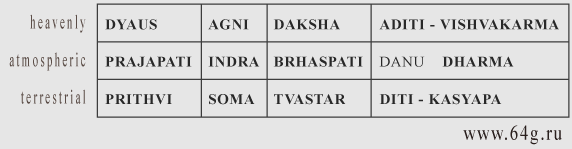
Sky and ground in the beginning were uniform, namely DYAUS and PRITHVI were one
monolithic divine entity.
Then PRAJAPATI has divided sky and ground, and as a result INDRA also AGNI and
SOMA have arisen, namely there were fire and water which in aggregate with sky
and ground have formed four world elements.
DYAUS - sky - air.
PRITHVI - ground - earth.
AGNI - fire.
SOMA - water.
INDRA - uniting center of four elements.
DYAUS and PRITHVI became parents of INDRA also AGNI and SOMA.
Then PRAJAPATI has created DAKSHA and TVASTAR also BRHASPATI, and as a result
there were three levels of universe.
DAKSHA - heavenly level.
BRHASPATI - atmospheric level.
TVASTAR - terrestrial level.
In the subsequent DAKSHA and TVASTAR became primogenitors of gods, and BRHASPATI
began to exist as regulator of world order and law in mutual relations of DAKSHA and TVASTAR.
DAKSHA has generated ADITI also DITI and DANU, namely three daughters.
TVASTAR has generated KASYAPA and VISHVAKARMAN, namely two sons.
ADITI and VISHVAKARMAN became parents of heavenly gods Adityas.
DANU and KASYAPA became parents of gigantic demons Danavas.
DITI and KASYAPA became parents of demons Daityas.
Gigantic demons Danavas began to exist on
atmospheric level of universe, that contradicted principles of world order.
Therefore INDRA together with heavenly gods has destroyed Danavas. Also INDRA has broken union of DANU with KASYAPA.
After that BRHASPATI on atmospheric level of universe has created DHARMA or god
who has received ten daughters of DAKSHA as wives.
Also KASYAPA on terrestrial level of universe has received from DAKSHA ten
daughters who have been opposed to wives of DHARMA.
Wives of DHARMA became personifications of validity and moral nobleness.
Wives of KASYAPA became primogenitors of various classes of demonic entities in
space of terrestrial level of universe.
Also 27 daughters of DAKSHA became wives of SOMA.
As a result divine formation of universe has been completed, and hierarchical
pantheon of 33 gods has been created.
Heavenly gods or Adityas - children of VISHVAKARMAN
who is father, also ADITI who is mother.
ADITI according to meanings of words in Vedic Sanskrit is mythological goddess
who personifies boundless infinity of heavenly space.
ADITI has been given as wife to KASYAPA, but this mythological goddess has been
stolen by VISHVAKARMAN.
Heavenly gods have refused own father, also goddess ADITI has renounced from
VISHVAKARMAN after birth of children, because VISHVAKARMAN was generation of TVASTAR.
Some heavenly gods have other parents, namely MITRA, VARUNA, ARYAMAN,
ANSA, BHAGA, DHATR, VISHNU, VIVASVAT are eight children of goddess ADITI. Other
deities SURYA, SAVITR, PUSHAN, USHAS concern to the category of heavenly gods
but they have been born as children of DYAUS and PRITHVI, and in essence as
brothers of INDRA, AGNI, SOMA, also DHRUVA, PRATYUSHA, CHANDRA.
Read detail information about 12 heavenly gods of Vedic mythology on 2nd and
3rd pages in this section of website.
Atmospheric gods or Rudras.
INDRA, VAYU, VATA, also ASHVINS were born as children of DYAUS and PRITHVI.
RUDRA, MATARISHVAN, PARJANYA, APAS were created by PRAJAPATI, and in essence
these divine entities are brothers of DAKSHA and TVASTAR also BRHASPATI.
AHY BUDHNYA, APAM NAPAT, ADJA ECAPAD, TRITA APTYA were created by BRHASPATI and
these divine entities are brothers of DHARMA.
Read detail information about 11 atmospheric gods and 2 twins ASHVINS of
Vrdic mythology on 4th and 5th pages in this section of website.
Terrestrial gods or Vasus.
DHRUVA, PRATYUSHA, CHANDRA were born as children of DYAUS and PRITHVI, namely
these divine entities are brothers of INDRA, AGNI, SOMA, also SURYA, SAVITR, PUSHAN, USHAS,
also VAYU and VATA, also twins ASHVINS.
APA, ANILA, DHARA, PAVAKA, PRABHASA was generation of TVASTAR, namely these
divine entities are brothers of KASYAPA and VISHVAKARMAN.
Read detail information about 8 terrestrial gods of Vedic mythology on 7th
page in this section of website.
Total key for generation of 33 gods of basic hierarchy within Vedic myths are 9
initial divine entities which correspond to magic square of nine numerological
numbers, that is shown on the chart.
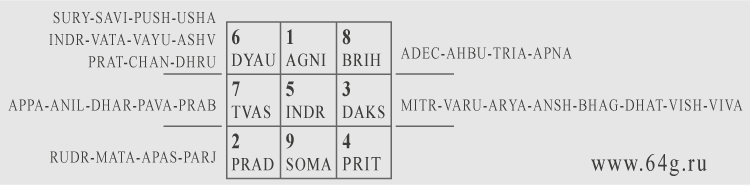
Numbers 6 and 4 - DYAU and PRIT - DYAUS and PRITHVI are primogenitors of
12 gods in basic hierarchy of Vedic mythology.
Heavenly level of universe.
SURY - SURYA.
SAVI - SAVITR.
PUSH - PUSHAN.
USHA - USHAS.
Atmospheric level of universe.
INDR - INDRA.
VATA - VATA.
VAYU - VAYU.
ASHV - ASHVINS.
Terrestrial level of universe.
PRAT - PRATYUSHA,.
CHAN - CHANDRA.
DHRU - DHRUVA.
Number 2 - PRAD - PRAJAPATI is primogenitor of 4 gods in basic hierarchy
of Vedic mythology.
Atmospheric level of universe.
RUDR - RUDRA.
MATA- MATARISHVAN.
APAS - APAS.
PARJ - PARJANYA.
Number 8 - BRIH - BRHASPATI is primogenitor of 4 gods in basic hierarchy
of Vedic mythology.
Atmospheric level of universe.
ADEC - ADJA ECAPAD.
AHBU - AHY BUDHNYA.
TRIA - TRITA APTYA.
APNA - APAM NAPAT.
Number 7 - TVAS - TVASTAR is primogenitor of 5 gods in basic hierarchy of
Vedic mythology.
Terrestrial level of universe.
APPA - APA.
ANIL - ANILA.
DHAR - DHARA.
PAVA - PAVAKA.
PRAB - PRABHASA.
Number 3 - DAKS - DAKSHA is primogenitor of 8 gods in basic hierarchy of
Vedic mythology.
Heavenly level of universe.
MITR - MITRA.
VARU - VARUNA.
ARYA - ARYAMAN.
ANSH - ANSA.
BHAG - BHAGA.
DHAT - DHATR.
VISH - VISHNU.
VIVA - VIVASVAT.
Number 1 - AGNI - AGNI is not primogenitor of gods in basic hierarchy.
But AGNI is essential initial deity as prototype of sun which is connected with
solar divine entities.
Number 9 - SOMA - SOMA is not primogenitor of gods in basic hierarchy.
But SOMA is essential initial deity as prototype of moon which is connected with
lunar divine entities.
Number 5 - INDR - INDRA is initial deity and god of basic hierarchy.
According to the listed cognate interrelations of gods it is possible to analyze
phonetic parities which are peculiar to sounds of human speech during formation of words.
Following page describes parities of sounds Б П Д Т Г К М Н Л Р Ц Ч with heavenly Vedic mythological deities, also with zodiacal signs and planets in astrology.