
-
       Page 8.
|
|
Numbers of letters and numerology of English language. Information of this page can be interesting to linguists who investigate symbols of ancient runic alphabetic systems, because number of original English or Anglo-Saxon runes is equal to quantity of letters and phonemes of contemporary Russian language. |
-
Slavic Cyrillic alphabet is the set of graphical symbols which designated
sounds of speech in contexts of different age-old Slavonic languages. Namely 43
letters in Cyrillic alphabetic system designated wide acoustic range of phonemes
which in contemporary Slavonic languages are absent partially, and in particular
the modern Russian alphabet has only 33 letters which are sufficient for
designation of 33 existing phonemes.
Actually Cyrillic alphabet was a phonetic linguistic construction, because
letters have been coordinated with phonemes or otherwise to tell alphabetic
characters were organic for acoustic complex of sounds which can be said by
means of articulation and which sounded in words of Slavonic languages. And also
contemporary Russian alphabet is phonetic and organic for sounds of speech, as
letters correspond to phonemes in words of Russian language, though quantity of
alphabetic characters and phonemes is smaller in comparison with Cyrillic symbols.
Therefore numerical meanings of words and names of Russian language in the
context of numerology can be calculated by means of alphabetic letters, and
results of calculations will correspond to phonemes. But letters of alphabets in
other languages not always correspond to phonemes, and consequently there can be
more complex numerological calculations by means of phonetic transcriptions if
it is necessary to find numerical meanings of words or names not only according
to alphabetic symbols, but also according to acoustic soundings.
For example, the English alphabet is not phonetic as in words of English
language there are no unequivocal ratios of letters with phonemes. Namely
letters or alphabetic characters are graphical symbols which are not organic for
acoustic range of sounds in words of English language.
The primary English or Anglo-Saxon alphabet was runic, namely consisted of runes
or original alphabetic symbols which was approximately 33. But now Englishmen or
Britishers apply graphical symbols of Latin alphabet for record of speech sounds
in words of English language, and as a result some phonemes have been designated
by combinations of letters or compared to different alphabetic characters.
Because 26 letters of Latin alphabet are not organic for sounds of speech in
English language. And also because French either Italian, or other words of
foreign origin have been written according to spelling rules of original
linguistics, and as a result in English language there are no unequivocal ratios
of letters with phonemes.
Therefore it is necessary to calculate numerical values of English words by
means of phonetic transcriptions if it is necessary to find ratios of acoustic
soundings with numbers in numerology. For this purpose it is possible to write
phonetic transcriptions of words or names of English language by means of 33
letters of Russian alphabet, as shown below on this page.
Russian letters are shown at the left, and on the right in square brackets
corresponding phonemes of English language according to the international
phonetic alphabet. And also examples of English words in which phonemes have
sounding are specified on the right.
Some letters of the Russian alphabet correspond to several phonemes of English language.
Russian letters for phonemes of English language.
|
Russian |
Phonetic transcriptions. Examples of letters in words. |
1.  |
 - letters A+R and A in
words CAR, CLASS, PAST, TASK, GRASP, HALF, PALM, PLANT, and also Latin
letters EA+R in word HEART. - letters A+R and A in
words CAR, CLASS, PAST, TASK, GRASP, HALF, PALM, PLANT, and also Latin
letters EA+R in word HEART.
|
2.  |
 - letter B in BOOK. - letter B in BOOK. |
3.  |
 - letter V in VOICE. - letter V in VOICE.
|
4.  |
 - letter G in GIVE. - letter G in GIVE. |
5.  |
 - letter D in DREAM. - letter D in DREAM.
|
6.  |
 - letters YE in YETI. - letters YE in YETI.If transcription of a word has this combination of phonetic signs then it is impossible to summarize numerical values, but numerological number of Russian letter Е is considered. |
7.  |
 - letters I+R, E+R, U+R,
EA+R in words SHIRT, BERTH, FUR, LEARN. - letters I+R, E+R, U+R,
EA+R in words SHIRT, BERTH, FUR, LEARN.
|
8.  |
 - letters S and G in
words PLEASURE and BOURGEOIS. - letters S and G in
words PLEASURE and BOURGEOIS. |
9.  |
 - letters Z and X in
words ZERO and XYLOPHONE. - letters Z and X in
words ZERO and XYLOPHONE. |
10.  |
 - letters E, EE, EA, IE,
EI in words HE, GREEN, READ, FIELD, RECEIVE. - letters E, EE, EA, IE,
EI in words HE, GREEN, READ, FIELD, RECEIVE.
|
11.  |
 - letter Y in YETI. - letter Y in YETI.
|
12.  |
 - letters K and C in
words KIND and CAT. - letters K and C in
words KIND and CAT. |
13.  |
 - letter L in LIGHT. - letter L in LIGHT. |
14.  |
 - letter M in MIND. - letter M in MIND. |
15.  |

 - letter N in words
NUMEROLOGY or LANGUAGE. - letter N in words
NUMEROLOGY or LANGUAGE. |
16.  |

 - letter O in words
NOVEMBER and DOG. - letter O in words
NOVEMBER and DOG.
|
17.  |
 - letter P in PLANET. - letter P in PLANET. |
18.  |
 - letter R in READ. - letter R in READ. |
19.  |
 - letters S and C in
words SEE and CIPHER. - letters S and C in
words SEE and CIPHER.
|
20.  |
 - letter T in TIME or
combination of letters TH in the name BARTHOLOMEW. - letter T in TIME or
combination of letters TH in the name BARTHOLOMEW. |
21.  |
 - letter U in PUT. - letter U in PUT.
|
22.  |
 - letter F and sound
combination PH in words FACE and PHYSIOGNOMY. - letter F and sound
combination PH in words FACE and PHYSIOGNOMY.
|
23.  |
 - letter H in HOW. - letter H in HOW. |
24.  |
There is no appropriate phonetic transcription, but letter C in
CIVILIZATION is comparable to this symbol of Russian alphabet. |
25.  |
 - letters CH in CHAIN. - letters CH in CHAIN. |
26.  |
 - letters SH, TI, S, SS,
C in words SHORT, SECTION, TENSION, PRESSURE, OCEAN. - letters SH, TI, S, SS,
C in words SHORT, SECTION, TENSION, PRESSURE, OCEAN. |
27.  |
Corresponding phonetic transcription is absent, but letters CH in CHEEK
can be estimated as numerical conformity to this symbol of Russian alphabet. |
28.  |
There is no appropriate phonetic transcription but letter J in OBJECT
can be estimated as conformity to the hard sign in Russian alphabetic system. |
29.  |
 - letter I before
consonants but outside of sound combinations - letter I before
consonants but outside of sound combinations


 . . |
30.  |
Corresponding phonetic transcription is absent, but in some cases
numerical value of Russian alphabetic soft sign is necessary for
considering after consonants before iotated vowels. For example, between
letters F and U in FUTURE. |
31.  |

 - letters YOU in YOUTH. - letters YOU in YOUTH.If transcription of a word has these combinations of phonetic signs then numerical values are not summarized, but numerological number of Russian letter Ю is considered. |
32.  |
 - letter E in PEN. - letter E in PEN.
|
33.  |


 - letters YA and YOU
in words YARN, YANKEE, YOUNG, YAHOO. - letters YA and YOU
in words YARN, YANKEE, YOUNG, YAHOO.If in transcription of a word there are these sign combinations of international phonetic alphabet then it is impossible to summarize numerical values of two signs, but it is necessary to consider number of the Russian letter Я.
In the listed parities of Russian letters with phonemes of English
language there can be discrepancies as I am not professional or
qualified linguist. |
-
Comparison of phonetic transcriptions of words or names of English language
with Russian letters allows to calculate numerical values, because Russian
alphabetic system corresponds to numbers of duodecimal scale of mathematical
notation, and also is derivative from the Slavic alphabet in which characters or
graphical signs form sacral azbuka. Namely because Russian letters possess names
or nominal meanings which express philosophical concepts and metalinguistic
senses, and in essence allow to understand values of numbers in numerology.
Below look the summary table according to which phonemes of English language and
letters of Russian alphabet correspond with numerological numbers within
duodecimal scale of mathematical notation.
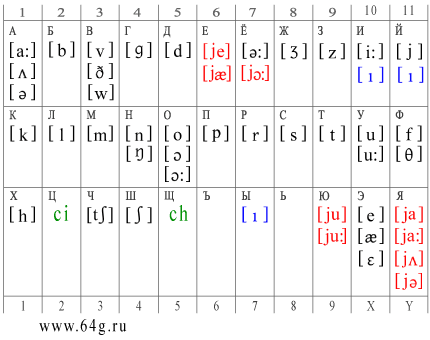 |
Decimal numbers are shown below, and numerical signs or
ciphers of duodecimal scale of mathematical notation are above shown. Numerological calculations can be carried out by means of decimal numbers, and then there can be conversion to duodecimal digital values by means of the numerical square which is shown on 4th page in this section of website. Blue color shows ratio of English phoneme I with different Russian letters. Red color shows phonetic transcriptions of English sound combinations in which it is impossible to summarize numerical values of two signs, but it is necessary to consider numerological number of one corresponding Russian letter. Green color shows English letters CH and CI which in some cases correspond with characters Щ and Ц in the Russian alphabet. |
For realization of numerological calculations use transcriptions of English
words from any dictionary, but it is necessary to transform symbols of the
international phonetic alphabet to Russian letters.
For example, phonetic transcription of the word FUTURE.
 - ФЬЮЧА 11+8+9+3+1=32 according to decimal numbers, or 28 (two dozens and
eight units) in the context of duodecimal scale of mathematical notation.
- ФЬЮЧА 11+8+9+3+1=32 according to decimal numbers, or 28 (two dozens and
eight units) in the context of duodecimal scale of mathematical notation.
Pay attention that letter F is the soft consonant before jotated vowel sound,
and consequently the soft sign Ь is necessary between letters F and U
according to rules of Russian language.
And also pay attention that numerical values of two signs in the sound
combination JU do not take into consideration, but numerological number of the
letter Ю is considered.
Following page results information about numerology and numerical values of human names, and also ratio of numbers with psychological characteristics of people.
Also within this section of website look the information about Russian and Slavic letters, sacral azbuka of Slavonic languages and figurative geometry of words, acoustic parameters of phonemes and numerology of human speech, mathematical and phonetic structures of alphabets, oracle of mantic predictions in puzzles and decimal numerological chart of names.

 - letters U, O, OU, OO
in words GUN, LOVE, COUNTRY, FLOOD.
- letters U, O, OU, OO
in words GUN, LOVE, COUNTRY, FLOOD. in sound combinations


 - letters RE in words CARE and THERE.
 - letter W in WAS.
 - letters TH in THIS.
 - letters YORE and YAW
in words YORE and YAWL.
- letters YORE and YAW
in words YORE and YAWL. - letters OR, AL, AU,
AW, AUGH, OUGH, AR in words HORSE, CALL, AUTUMN, DRAW, DAUGHTER, THOUGHT, WAR.
- letters OR, AL, AU,
AW, AUGH, OUGH, AR in words HORSE, CALL, AUTUMN, DRAW, DAUGHTER, THOUGHT, WAR. - disappearing sound
in words IDOL and VISION.
- disappearing sound
in words IDOL and VISION. - there can be
combination of letters TH corresponds with this phoneme.
- there can be
combination of letters TH corresponds with this phoneme. - letters O, OO, OU in
words WHO, SPOON, GROUP.
- letters O, OO, OU in
words WHO, SPOON, GROUP. - letter A in words CAT or MAN.