
-
      Page 7.
|
|
Numerology and numerical values of human speech. Information of this webpage can interest not only people who are keen on esoteric occult knowledge and numerology, but also scientific linguists and philologists. As according to ratio of letters and sounds of human speech with numbers in numerology it is possible to analyze phonetic interrelations of words in different languages, that can be considered as the new direction of linguistic science, namely as numerological linguistics. |
-
The structure of languages is compound construction or otherwise to tell
multilevel complex, as words can be apprehended by hearing as phonetic soundings
of human speech, or by eyes as graphical symbols or written signs. Namely data
carriers of semantic meanings and senses in languages are words which can be
said by means of speech or organs of articulation or can be written by letters
of alphabet. Hence, numerical values of words from the view point of numerology
can be connected with alphabetic letters by means of which people write words.
Or with phonetic soundings by means of which people say words.
Each alphabet has individual quantity of alphabetic symbols which according to
various numerical matrixes or otherwise tell to mathematical tables can to be
compared to numbers in numerology. In particular ancient Greek alphabet
corresponds with numerological matrix of numerical signs of decimal scale of
mathematical notation. Or letters of contemporary Russian alphabet and
alphabetic symbols of Phoenician writing can be correlated with numerological
matrix of duodecimal numbers, that is described on third page in this section of website.
But sounds of speech or otherwise to tell phonemes of languages not always
correspond to letters of alphabets. Therefore methods of numerological
calculations of numerical word values according to sounds of human speech are
more complex. In particular, alphabetic symbols mismatch sounds in English or
French languages, and consequently there should be application of complex
calculations which allow to correlate phonetic soundings of words or human names
to numbers in numerology.
There is the international phonetic alphabet or otherwise to tell linguistic
system of graphical symbols which designate diverse sounds of human speech in
different languages of mankind. But linguistic system of international phonetic
alphabet is not structured for numerology. Namely graphical symbols are not
systematized as in the Slavic Cyrillic alphabet or in the alphabetic system of
Phoenician writing, that does not allow to correlate international phonetic
symbols with numerological numbers.
Quantity of symbols in the international phonetic alphabet is connected with
physiological parameters of articulation or organs of speech, and in essence
corresponds with spatial range of acoustic waves which can be considered as
mathematical sizes of sounds or phonemes and can be correlated to numbers in
numerology. But any structural system or numerological matrix according to which
sounds of speech of different human languages correspond to numbers now does not exist.
Therefore it is possible to calculate numerical meanings of word or names
according to ratio of alphabetic letters with numbers even if characters of
alphabet mismatch phonetic soundings of words. Or for numerological calculations
it is possible to use alphabetic symbols which designate sounds of speech and
phonemes of Russian language. Because 33 Russian letters form unique phonetic
construction which is actually equivalent to all complex of symbols in the
international phonetic alphabet and can be used as universal metalinguistic
system of human speech.
And also 33 Russian letters are comparable to hierarchy of deities in ancient
Vedic mythology or chronological periods of time in the calendar of Maya
civilization, that allows to use contemporary Russian alphabet as universal for
all languages of mankind, that is described on pages of this website in sections
which have names: letters and
words of gods.
As a matter of fact 33 letters of contemporary Russian alphabet can be
considered as universal system of graphical signs which correspond with
numerological numbers in the context of duodecimal notation. And consequently
Russian alphabet allows to calculate numerical meanings of words or human names
within those languages where phonetic soundings do not coincide with alphabetic symbols.
Words of foreign languages should be written by means of Russian letters for
this task, or otherwise tell numerical values of English or French words should
be calculated according to phonetic transcriptions which are written by letters
of Russian alphabet.
In transcriptions it is necessary to consider that alphabetic letters in words
of contemporary Russian language designate varied phonemes or otherwise to tell
aggregate groups of speech sounds.
-
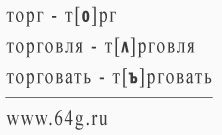 |
For example, the letter О in words ТОРГ
ТОРГОВЛЯ ТОРГОВАТЬ designates varied sounds or otherwise to tell
variations of three phonemes.
|
Variations of phoneme О in all three cases correspond with the letter
О, also correspond with number which corresponds to this alphabetic
character within numerological matrixes of Russian alphabet. It is possible to
tell that the letter О in the shown example designates phonetic soundings
which are different variants of phoneme О, but variants in all three
cases have one numerical value.
According to the shown example it is possible to see that system of character in
the contemporary Russian alphabet corresponds to phonemes in words of language
if to not consider varied soundings, or otherwise to tell changeable
articulations and ambiguous pronunciations of speech sounds. Therefore Russian
alphabet and language are unique from the view point of numerology, as numerical
values of letters and phonemes are identical.
Hence, the Russian alphabet can be considered as universal for other languages
of human civilization, as alphabetic system allows to calculate ratio of words
with numerological numbers according to phonetic soundings. Namely allows to
write phonetic transcriptions of foreign words or names by Russian letters, and
to calculate numerical values according to ratio of speech sounds with numbers in numerology.
But in phonetic transcriptions it is necessary to interpolate linguistic rules
of Russian language on foreign words.
Look linguistic rules of Russian language on parallel Russian-speaking page
of this website: www.wordgame.64g.ru/meta/meta7.htm.
For example, phonetic transcription of English name BARTHOLOMEW looks like
БАРТОЛОМЬЮ according to rules of Russian language, and accordingly numerical
value of this name in view of principles of metalinguistic numerology of human
speech is 2+1+7+9+5+2+5+3+8+9=51.
Pay attention that numerical value 51 is calculated according to ciphers of
decimal mathematical notation, but the result of numerological calculation will
be number 43 (four dozens and three units) according to duodecimal digits.
Tables for numerological calculations and conversion of decimal ciphers in
duodecimal digits are shown on fourth page in this section of website.
English name BARTHOLOMEW corresponds to Russian ВАРФОЛОМЕЙ.
In the end of this page it is necessary to tell that any alphabet can be
considered as a complex of graphical signs which designate physical sizes and
acoustic parameters of human speech. And also any alphabet can express
mathematical structures of language within which words are connected with
numbers in numerology. But contemporary Russian alphabetic system is unique,
namely possesses optimal set of phonemes within the international phonetic
alphabet which actually is global universal system of human articulation or set
of all possible sounds of speech which can be said.
Mathematical and phonetic structures of Russian alphabet correspond to
chronological cycles and periods of time in the calendar of civilization Maya,
and also hierarchy of 33 gods in Vedic mythology which is derivative from
ancient Indo-European myths and common language of all Aryan people from India
up to Iceland, and also from Swiss Alps up to Siberian Altai. Therefore it is
possible to assume that contemporary Russian alphabet was generated as a result
of complex cultural processes as image of common and uniform acoustic system of
human speech, and also as general logical-linguistic construction which is
connected with duodecimal scale of mathematical notation which was known in the
age-old world within nations of Indo-European civilization and was a basis of
ancient numerology, according to which letters and numbers designated calendar
time and corresponded with cosmological structures of cosmic space.
It is actually possible to draw a conclusion about providential evolution of
languages and not casual nature of human speech which is image of cosmic Logos
from the view point of Greek philosophy, or the divine Word in the context of
Christian religious-philosophical concepts.
Following page describes linguistic ratio of English phonemes or sounds of speech with letters of Russian alphabet. Namely rules according to which it is possible to write phonetic transcriptions of English words by Russian alphabetic symbols and to calculate numerical values in the context of duodecimal numerological matrix. Namely next page shows information about numerology of English language.
Besides in this section of website there is information about metalinguistic philosophical concepts and names of Russian letters, characters of Latin and cabbalistic alphabets, mystical gematria in Cabbala and visual images of numerology, sounds of speech and phonemes of languages, predictions of words by logic puzzles and table of numerological calculations.


 - obvious accented sound О.
 - unaccented sound О or А.
 - unobvious sound.