Page 5.
|
|
Numerology of numbers and spectrum of alphabetic letters.
Information of this online of page can be interesting in psychology
and psychotherapy as colors of rainbow iridescent spectrum are favorable
or adverse for human perception according to spectral parameters of
alphabetic letters in names of people. |
-
Contemporary Russian alphabet has unique phonetic and mathematical structure
from the view point of linguistics and numerologies. Because quantity of letters
or alphabetic characters precisely corresponds to phonemes and sounds of speech
which can be heard in words of Russian language. Actually Russian alphabet has
universal linguistic construction or design which is unique in comparison with
alphabetic systems of other foreign languages.
Miraculous historical changes of Russian language and modifications of symbols
in alphabet have led to occurrence of contemporary alphabetic system in which
the structure or order of letters precisely corresponds with phonetics of speech
and phonological acoustic parameters of articulation.
Therefore letters of Russian alphabet can be considered not only as linguistic
symbols but also as mathematical signs which correspond with numerological
numbers and acoustic parameters of speech. Namely human perception of world
spaces and volumes by means of hearing is caused by influence of acoustic waves
and other physical vibrations, and consequently alphabetic letters can be
considered as symbols which specify wave sizes. It is possible to speak that
letters designate numerical mathematical sizes of sound waves and amplitudes of
physical vibrations according to which people perceive words.
Russian alphabet has 10 vowel letters and sounds which form the symmetric
phonetic scale, as shown in on the chart.
Pay attention that number 10 is sacral from the view point of occult
Cabbalistic philosophy, and also in view of numerology, as it is quantity of
Sefirot or Sephirot or mystical digital symbols in Cabbala or Kabala.
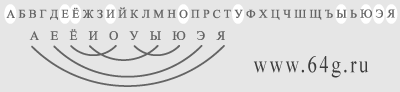 |
The chart shows sequential order of vowel letters
according with standard sequence of symbols or characters in the
academic alphabet, but position of letter Э
is changed, as it is required for symmetric arrangement. Namely letters Э and Ю have alternating positions. Letter Э has been included in the Russian alphabet on 1708 and consequently her sequential position is not unconditional or doubtless. New displaced position of this letter can be justified by order of symbols in the Slavic alphabet at correlation to 35th Cyrillic alphabetic character. |
Symmetric on the chart are following А-Я Э-Е О-Ё У-Ю И-Ы
letters of alphabet, and also corresponding iotated and uniotated pairs of
phonetic sounds of speech.
Besides Russian language and alphabet have 10 voiced (sonorous) and 10 unvoiced
consonant phonemes and letters.
If to consider iotating sound Й as vowel phoneme, also if soft
mark Ь concerns with voiced and firm mark Ъ concerns with unvoiced
consonants then Russian alphabet has 11 letters in three phonetic groups.
Number 11 too is sacral from the view point of numerology, as eleven
numerical signs are comparable with quantity of letters in the Cabbalistic
alphabet and ancient Phoenician writing, and also with quantity of major Arcana
of Tarot fortunetelling cards, that is described on third page in this section
of website.
Eleven letters in three phonetic groups of Russian alphabet can be correlated to
colors, and in essence wave acoustic characteristics of speech sounds can be
compared to physical waves which correspond to optical spectral parameters of
iridescent rainbow spectrum, as shown in the table.
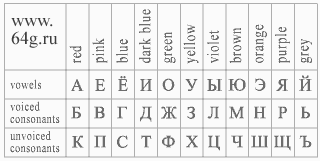 |
Basic obvious colour parameters belong to vowel
letters, and consonants are put in conformity to vowels. It is possible to consider colors of vowel letters as more depth or strength, and spectral parameters of sonorous and unvoiced consonants can be correlated to less depth colour shades. |
-
The following chart shows geometrical principles or otherwise to tell spatial laws according to which vowel letters and phonemes of Russian language and alphabet correspond to colors of rainbow spectrum.
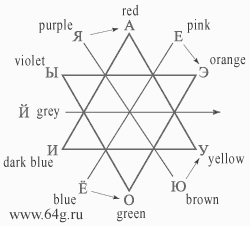 |
Я А Е - purple - red - pink. Э - orange. У Ю - yellow - brown. О - green. Ё - blue. И - dark blue. Ы - violet. Look information on eighth page in this section of website for comparison of Russian letters with vowel phonemes of English language. |
Letter Й forms the axis of grey color.
Letters Я (purple) and А (red), Е (pink) and Э
(orange), Ё (blue) and О (green), Ю (brown) and У
(yellow) form pairs of iotated and uniotated phonemes.
Letters А (red), И (dark blue), У
(yellow) form the triangle of pure (not mixed) colors.
Letters Ы (violet), О (green), Э
(orange) form the triangle of mixed colors as violet is mixture of red with
blue, green is combination of blue with yellow, orange is connection of red with yellow.
Triangles of pure and mixed colors are interconnected, namely violet is located
between red and blue, orange between red and yellow, green between blue and yellow.
Letters Я (purple) and Ю (brown) form the axis of darken colors.
Letters Е (pink) and Ё (blue) form the axis of lighten colors.
Letters А (red) and О (green), Ы (violet) and У
(yellow), И (dark blue) and Э (orange) are located opposite and form contrast pairs of colors.
Letters Е (pink) and Ё (blue), and also Я (purple) and Ю (brown) are located opposite,
but they are not contrast spectral pairs.
Besides in the shown chart it is possible to see many other spectral and
phonetic laws or ratios of alphabetic letters and sounds of human speech.
Look more detailed information about colour spectral parameters of
vowel phonemes of speech and letters of
contemporary Russian alphabet, and also about rainbow iridescent spectrum of
Cyrillic alphabetic signs, on pages of this website in section:
names of gods.
Ratio of letter А with red color is indisputable, also colour spectral parameters of letters Я
Е Э in top hemisphere of the shown chart are unconditional.
Pairs of letters Ё-О and Ю-У
in bottom hemisphere can have other positions, namely it is possible to assume, that sounds Ю
is brown, У is yellow, Ё is blue, О
is green, but nevertheless it seems to me that the shown spectral ratios are correct.
Letter Й is conditionally compared
to grey color, as the corresponding iotating phoneme is involved in iotated
vowels Я Е Ё Ю which correspond with darken
and lighten colors, that is caused with intensity of grey colour shades. But
actually at segment of iridescent spectrum between blue and violet there is a
mixed blue-violet color.
At more detailed differentiation of iridescent spectrum it is possible to
allocate more colour shades which can be compared to acoustic characteristics of
vowel sounds.
Between letters Э (orange) and У
(yellow) there can be a sound corresponding with bright-citric color. Between letters А
(red) and Е (pink) there can be a
sound which is complex combination of crimson and scarlet colour shades. And
also between other letters there can be sounds which correspond to more detailed
differentiation of iridescent rainbow spectrum.
Pay attention that between letters Ы
(violet) and Я (purple), also
on the place of letter Й there can be invisible infra-red
and ultra-violet colors which correspond to not heard infrasound and ultrasound
acoustic parameters.
The iridescent spectrum of rainbow influences consciousness of people, also
sounds of speech possess similar influence on mentality and connection with
sequence of psycho-physiological processes of human organism.
Я А Е - first or initial stage of psycho-physiological processes -
initiative and excitation.
These sounds of speech are raising and stimulating activity as purple and red
and pink correspond to colors of sun which appears above horizon.
Э - second stage of psycho-physiological processes - achievement of
result and satisfaction.
This sound of speech is cheerful and vital as orange color corresponds to
spectral parameters of sun in zenith.
У Ю - third stage of psycho-physiological processes - exhaustion and powerlessness.
These sounds of speech are oppressing as yellow and brown correspond to color of
autumn foliage of trees and withering grasses.
О - fourth stage of psycho-physiological processes - rest and inactivity.
This sound of speech is calming as green is color of alive plants which form
cool shadows for protection from midday sunlight.
Ё И - fifth stage of psycho-physiological processes - detachment and indifference.
These sounds of speech are pacifying as blue and dark blue correspond to
spectral parameters of day time or night sky which distracts attention of people
from surface of ground.
Ы - sixth stage of psycho-physiological processes - desire and expectation.
This sound of speech is straining as violet corresponds to color of night sky
before dawn when occurrence of sun above horizon is expected, that precedes
excitation and activity, namely beginning of new cycle of psycho-physiological processes.
The listed associative interrelations with natural phenomena are conditional,
as actually colors of iridescent spectrum and sounds of speech have physical
parameters or otherwise to tell mathematical sizes of waves which influence
human perception. But however natural phenomena possess colour characteristics
which wonderfully correspond with emotional impressions or otherwise to tell
with mental associations which arise at visual perception of colors or as a
result of acoustic influence of speech soundings on hearing.
In total letters of alphabet form logic system of metalinguistic symbols or
signs which mean not only phonemes and sounds of speech, but also associate with
various natural phenomena and spectral characteristics of the visible world, and
also alphabetic characters symbolize physical acoustic parameters which can be
correlated to numbers in numerology.
When alphabetic letters and sounds of human speech develop in words then there
are linguistic formations of sounding compositions which render complex
psycho-physiological influence on mentality of people.
To understand psycho-physiological influence of words it is possible to
calculate numerical values of letters, and to consider linguistics of human
speech and language according to philosophical categories and mystical senses
which correspond to numbers in the context of numerology. Or it is possible to
use visual images and graphic representations in which letters of alphabet are
compared to colors of iridescent spectrum and geometrical figures in space of
the colour circle which is shown in following chart.
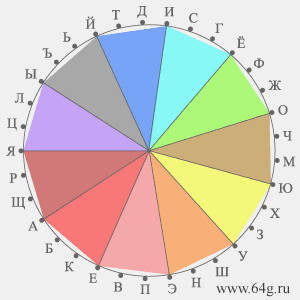 |
The colour spectral circle on the chart is divided into
11 multi-colored segments, to each of which there correspond 3
alphabetic letters. One letter is designation of vowel phoneme, and two
letters designate concordant consonant phonemes which are compared with
a color of vowel sound. For creation of visual images it is necessary to connect letters by lines according to sequence in words, and also it is necessary to paint spatial fields of the circle according to colour spectral parameters of letters. As a result it is possible to see combinations of colors which are the reason of emotional impressions and mental associations at perception of words. Look additional information on visual images and geometrical symbols of words on pages of other website: phantomgallery.64g.ru. |
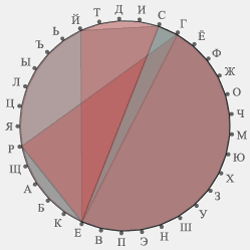
For example I bring to your attention graphic representations which are
visual images of human names.
The shown visual images of names are computer drawings which are limited by
technical parameters of computers, or otherwise to tell by colour scales of
monitors and displays, that allows to consider colors as inexact. But if it is
necessary to see real colors then exact spectral values can be calculated.
|
Name СЕРГЕЙ
Sergey.
|
Graphical algorithm of the shown visual images
consists that lines correspond with sequence of letters in names or
words. And lines form geometrical figures according to which colors of
iridescent spectrum fill round space. |
-
Visual images of other Russian names are shown in gallery:
DICTIONARY OF NAMES.
If there will be a necessity then it is possible to draw visual dictionary of
English names.
The gallery also shows duodecimal numbers and philosophical categories which
correspond to names in the context of numerology. Philosophical categories or
esoteric mystical values are not connected with psychological characteristics of
people, but they specify metalinguistic senses of names according to numerological numbers.
One - ИСТИНА TRUE as the Spirit is a source of truth.
Two - РОЖДЕНИЕ BIRTH as the Son is realization of existential spiritual beginning.
Three - ДИТЯ CHILD as children are actual embodiments of alive creatures.
Four - ЖЕЛАНИЕ DESIRE as the Essence of alive substances is shown in desires.
Five - СОЗИДАНИЕ CREATION as Transformation of substances grows out creativity.
Six - ТАЙНА SECRET or ПОЗНАНИЕ KNOWLEDGE as implicit reality hides mystery which people aspire to know.
Seven - ОДУХОТВОРЕНИЕ ENLIGHTENMENT or overcoming of implicit illusive reality.
Eight - ПРОЗРЕНИЕ DISCERNMENT or ПРОЗОРЛИВОСТЬ INSIGHT as obvious reality is
understanding of evidential veracity.
Nine - ВЕЛИЧИЕ GREATNESS or clearing comprehension of spiritual truth.
Ten - СУДЬБА DESTINY or ПРОВИДЕНИЕ FORESIGHT as true essence of
human nature is predetermination of divine providence.
Eleven - ЖИЗНЬ LIFE as human Soul aspires to absolute life.
Zero - СВОБОДА FREEDOM as this digital sign has no own numerical value, but the zero symbolizes unlimited
infinity in the context of numerology.
Following page results information about mantic or fortunetelling and predictive features of alphabetic letters. Namely about oracle of mantic words in puzzles.
Besides in this section of website it is possible to find information about letters and phonemes of languages, gematria and geometry of words, alphabet of Cyril and Methodius, puzzles as mantic operations and calculations of numerical esoteric senses of numbers, ancient Phoenician writing and names with astrological values.