-
 Page 2.
|
|
Metalinguistics of letters in the Russian alphabet. Information of this web page can be interesting not only in scientific linguistics, but also can interest researchers and scientists who study occult philosophy. As 33 letters of contemporary Russian alphabet form geometrical triangle which symbolizes three development stages of human personality or otherwise to tell "heavenly ladder" according to which evolution of soul occurs. |
-
Contemporary Russian alphabet has no azbuka as letters have no names, but
alphabetic symbols occur from Slavic graphical characters. Therefore it is
possible to consider phonetic conformity of Russian and Slavic letters, and as a
result symbols of contemporary alphabetic system can have names which Cyril and
Methodius have given letters.
In the contemporary Russian alphabet there are 33 letters, that differs from
number of symbols in Cyrillics as phonetic structure of language has changed and
some phonemes were not kept, or have been transformed according to historical
changes of speech. But however modern letters possess continuity with symbols of
Cyrillics, and consequently sacral azbuka of the Slavic alphabet is projected on
contemporary alphabetic system of Russian language.
Namely logic order of modern letters can be considered as metalinguistic formula
which is projection of sacral Slavic azbuka and possesses esoteric senses or
mystical values which correspond with names of Cyrillic alphabetic symbols.
Below look graphic symbols or characters of contemporary Russian alphabet are
compared to primary Slavic letters And also look philosophical meanings or
otherwise to tell categories which correspond to names and esoteric senses of
letters in Cyrilic azbuka.
The sacral esoteruc azbuka of Russian alphabet.
| LETTERS |
PHILOSOPHICAL CATEGORIES | |
| 1. |
   |
EVERYONE. Person (carrier of knowledge). Human subject (unit of existence). Individuality (unique originality of each human being). |
| 2. |
  |
LETTERS. Elements of language (marks of human dialogue). Symbols (multiple-valued semantic structures). Semiotic sign systems. |
| 3. |
   |
KNOWLEDGE. Knowledge of self consciousness. Interrelation of language with functions of thinking. Intelligence (associative perception of validity). |
| 4. |
  |
SAY (VERBS). Communicative words which are directed on understanding and dialogue between people. Coordination tools of human activity. Verbal expression of will. |
| 5. |
  |
KINDNESS. Moral benevolence. Decency of consciousness. Ethical principles. |
| 6. |
    |
CONSCIENCE. Self-estimation of acts. Duty and responsibilities of behavior which is determined by obligations. |
| 7. |
     |
HUMILITY. Submissive consent with destiny. Aware or unaware necessity of obedience. Meekness and resignation to people. |
| 8. |
  |
LIFE. Existential life (embodiment subsistence). Stimulus (aspiration to creation). |
| 9. |
   |
EARTH. Biosphere. Manned space of existence (coexistence) and ability to live. Physical substance of material life. |
| 10. |
  |
NAME. Names of people. Nominal word (influence of calling name). Nominative identification (personal image). |
| 11. |
 |
TRUE. Objective truth (comprehended prototype of original life). Aspiration to veritable rightfulness. |
| 12. |
   |
QUALITY. Qualitative characteristics of processes. Motives of human behavior and reasons of vital interests. |
| 13. |
  |
PEOPLE. Collective assembly of people (civilization). Mutual unification (emotional merge) of people. Integration of common interests. |
| 14. |
  |
IDEA. Ideological thinking. Public communications of human ideas (customs). Common opinion (mass consciousness in attitudes of people to events and facts). |
| 15. |
  |
NATION. Social continuum (society). State population. Common property and national values (commonwealth). Traditions. |
| 16. |
 |
COMMON SELF. Image of perfect governor (prototype of ideal world power). Cathedral generality. Pay attention that in the Slavic alphabet for the letter О there correspond words HE and FATHER, and consequently mental image of ideal world power is accession of the Divine law to the Earth. |
| 17. |
   |
PEACE. Law (fair coexistence of people). Pacification and public rights (normative regulation of human actions). Foundations of mutual relations. |
| 18. |
  |
SPEECH. Reference appeal to people. Formulating (rational) address in which ideas are organized. Substantiation of public saying. |
| 19. |
  |
WORD. Coordination of words with ideas of people. Perceived word which has understanding and recognition among people. Approving of words. |
| 20. |
  |
STATEMENT. Valid (creating) word. Due (establishing or initiating) word which influences consciousness of people. |
| 21. |
   |
REASON. Noosphere. Sphere of human ideas (concentration of knowledge). Education. |
| 22. |
   |
BELIEF. Trust without direct rational substantiations. Steadfast convictions of reason. |
| 23. |
  |
SPIRIT. Eternal and general initial beginning of the world. Absolute source of all real. |
| 24. |
  |
SON. Realization of spiritual beginning. Implementation of spirit. |
| 25. |
  |
WOMB (CHILD). Organic (actual) embodiment of alive essences. Birth origin of people. |
| 26. |
  |
SUBSTANCE. Alive substance (vital forms which are capable to modifications). |
| 27. |
  |
TRANSFORMATION. Conversions of a matter (psycho-physiological changes of substances). |
| 28. |
  |
IMPLICIT. Hidden veil which hides supernatural reality. Illusion which covers subjective (apparent) world. |
| 29. |
  |
ENLIGHTENMENT. Overcoming of border between implicit and obvious worlds. |
| 30. |
  |
EXPLICIT. Objective reality existing outside of subjective empirical world. Core essence of things and phenomena. Universe (generality of world spaces). |
| 31. |
  |
GREATNESS. Clearing. Genuine comprehension of true. |
| 32. |
 |
ESSENCE. Transcendental life. Predetermination of human life by the divine foresight. |
| 33. |
   |
SOUL. Absolute complete life. Connection of people with the spiritual beginning. |
-
According to the listed philosophical categories of letters it is possible to
do diverse verbal statements or logic phrases which express esoteric senses of
words in Russian language. Namely it is possible to form statements which
express supernatural metalinguistic senses or mystical values existing in words
outside of usual semantic meanings.
For example, letters of Russian alphabet in the word ОТЕЦ FATHER
correspond to philosophical categories ОН - УТВЕРЖДЕНИЕ - СОВЕСТЬ (ЕСТЕСТВО)
- СЫН HE - STATEMENT - CONSCIENCE (NATURE) - SON that can be a basis of
diverse logic phrases which express metalinguistic or esoteric senses of this
word.
Also according to philosophical categories of letters it is possible to do
logic statements which express metalinguistic esoteric senses of human names.
It is necessary to consider that the listed philosophical categories are terms
which mean abstract general and not universal concepts, that is terminology can
vary according to outlook and conclusions of different persons. But however
structural building of alphabet is universal logic system according to which
letters form sacral formula, and also correspond with numbers in numerology, and
in essence correspond with the global mathematical construction of world space,
and consequently have mystical coordination with esoteric principles and rules
which are determined by general divine laws of universe.
It is possible to tell that each person can understand philosophical categories
of alphabetic symbols from own view point of individual outlooks on life and
nature, but however logic system and construction of alphabet is universal
cosmological scheme within which letters correspond with mathematical and
numerological laws of the world validity, or otherwise to tell correspond with
esoteric senses which are included in the sacral formula or azbuka of Cyrillic
alphabetic system.
Actually the system of alphabet symbolizes mythological "world tree" or "heavenly
ladder" which specifies evolutional way or spiritual development levels of human
SOUL, that is comparable to three sides of metalinguistic triangle which is
shown on the chart.
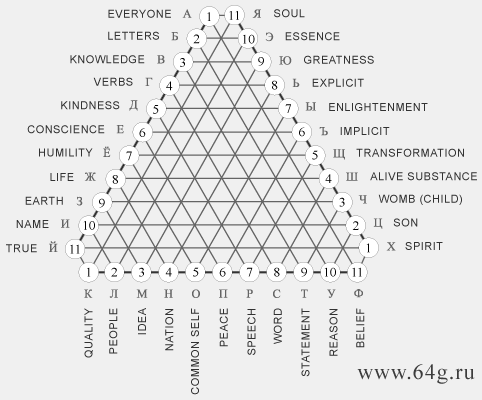 |
Letters of alphabet on sides of the shown metalinguistic triangle are compared to numbers according to which it is possible to calculate numerical word meanings or human names in the context of numerology, that is in detail described on following web pages in this part of website. |
Left side of metalinguistic triangle symbolizes evolution of
individuality, namely human personality at this stage of development realizes
TRUE or otherwise to tell own genuine calling or mission, and also gets public
QUALITY or identification with society.
Bottom side symbolizes evolution of public personality, namely
psycho-physiological development of a person at this stage consists that human
personality reaches BELIEF and corresponds with SPIRIT.
Right side symbolizes spiritual evolution, namely immortal human SOUL can
be formed according to this stage of development.
The left side of metalinguistic triangle can be named as descending, that
corresponds with physical birth of a PERSON and downstream movement in the
material world, or otherwise to tell with divine origin of personal conceiving
monad which proceeds from the God and as a result of psycho-physiological
developments reaches individual consciousness, and also realizes itself as a
part of society.
The bottom side of triangle can be named as surface or horizontal, that
corresponds to social development and identification of individual thinking with
collective consciousness of people, that as a result conducts to comprehension
of divine reason which is general but exists irrespective of public mind.
The right side of triangle can be named as ascending, that corresponds with
ascension of individual consciousness to top of divine reason.
The descending way of development corresponds with concepts of idealistic or
subjective philosophy according to which human consciousness does not depend on
being.
The horizontal way of development corresponds with concepts of materialistic or
social philosophy according to which being determines human consciousness.
The ascending way of development corresponds with concepts of transcendental
philosophy according to which consciousness determines being.
Or in aggregate three stages of development are comparable to concepts of
existential philosophy according to which individual consciousness and social
being are indivisible.
And also three stages of evolutional development of human personality and three
sides of metalinguistic triangle can be correlated to concepts of occult
hermetic philosophy which is system of secret esoteric knowledge in ancient
books written on behalf of Hermes Trismegistus or the Thrice-Greatest. As in
12th line of the well-known Emerald Tablet, also known as Smaragdine Table or
Tabula Smaragdina it is written:
"Therefore I am named as Trismegistus because I own three parts of universal
philosophy". Or other translation: "Hence I am called Hermes Trismegistus
since I have the three parts of the wisdom and Philosophy of the whole universe".
But it is necessary to consider that occult doctrine and esotericism of hermetic
philosophy are not high-grade from view point of theological concepts of Gnostic
Christianity. Because in the apocryphal Book of Jesus Christ's Wisdom or Sophia
of Jesus Christ or one of many Gnostic tractates from the Nag Hammadi codices it
is written: "All philosophers told that the LAW is directed on three ways.
Some people speak about the world that it goes itself. Others speak that the
foresight directs world. The thirds speak that destiny. But neither first, nor
second or third". Or other translation:
"All philosophers said that ordering of the world is directed in three ways.
Some of them say about the world that it is directed by itself. Others, that it
is providence (that directs it). Others, that it is fate. But it is none of
these".
And also in the apocryphal Gospel of apostle Phillip it is written: "wisdom
is fruitless without the SON".
Namely it is possible to tell conditionally that philosophers reach BELIEF on
the horizontal side and correspond with SPIRIT on the right side of
metalinguistic triangle, but do not comprehend the SON and consequently cannot
reach immortality of SOUL. Or it is possible to tell that philosophers do not
consider theological concepts of Christian religious philosophy which allows to
do the high-grade description of human personality unlike other occult
philosophical doctrines. And as a result philosophers do not realize original
QUALITY of human personality and immortality of mankind SOULS.
More detailed information on ratio of three sides of metalinguistic triangle
with concepts of different occult doctrines and esoteric teachings, and also
religious-philosophical directions of minds I shall try to publish in the future.
And also look information on philosophy of
human personality
on pages of other website: www.emotions.64g.ru.
Following page speaks about mathematical system of Russian and Slavic alphabets, and also about numerology of other alphabetic systems and writings. Namely about numerology of ancient alphabets.
Besides on following pages in this section of website look information about mantic alphabetic systems of ancient alphabets and Slavic azbuka, numerological numbers of letters and phonemes of English language, geometrical perception of words and speech sounds with colors, decimal and duodecimal numerical values.